In modern volleyball, blocking is no longer just a defensive reaction. It is an active tactical tool that shapes rallies, influences attacking decisions, and defines how a team controls space at the net. While spectators often focus on spikes and long rallies, experienced players and coaches understand that effective blocking can decide matches before the ball even crosses the net.
Blocking is the only skill in volleyball where players directly confront the opponent’s attack at its source. Its effectiveness depends not only on jumping ability, but on positioning, timing, reading the game, and coordination with backcourt defense. Teams that block well force predictable attacks and gain psychological advantage throughout the match.
How blocking defines modern volleyball dynamics
The role of the block has evolved alongside the speed of the game. With faster offenses and more varied attack patterns, blockers must make decisions in fractions of a second. A successful block does not always result in a direct point. More often, it slows the attack, channels the ball to defenders, or forces attackers into lower-percentage options.
Blocking also affects how opponents structure their offense. Strong blocking teams limit angles, close seams, and discourage certain combinations. This influence extends beyond individual rallies, shaping match tempo and offensive confidence over time.
At elite levels, blocking is planned as part of a defensive system rather than treated as an isolated skill. Each blocker has a role that connects directly to floor defense and transition play.
Technical principles behind effective blocking
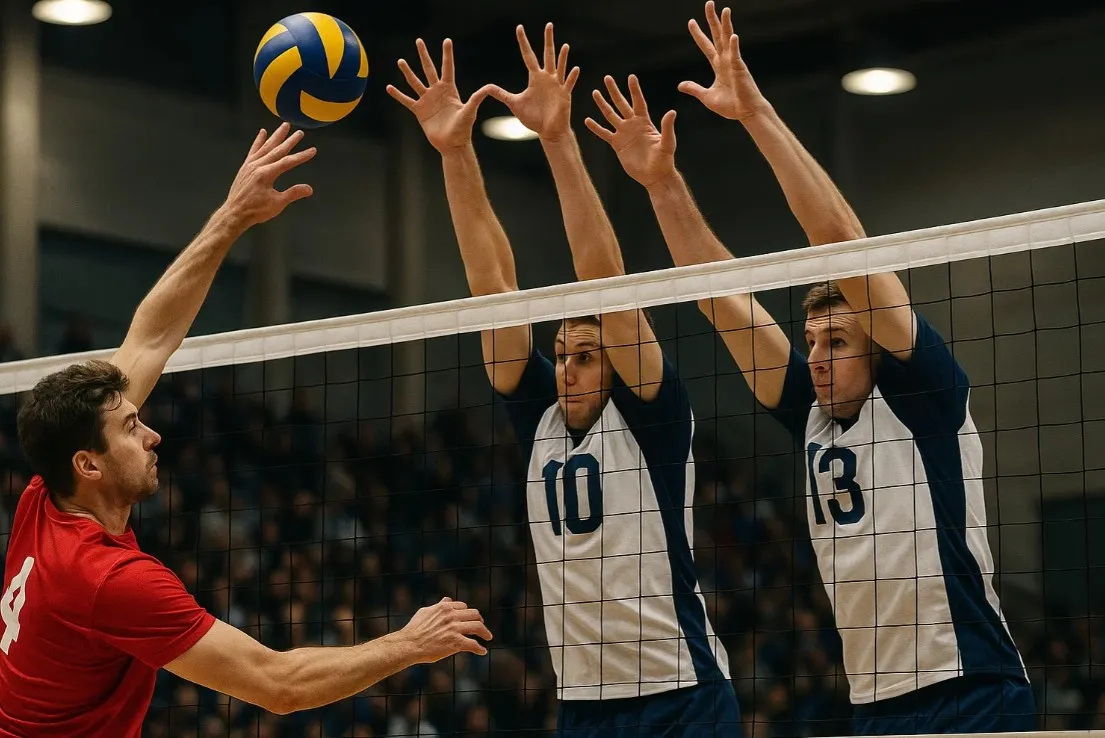
At its core, blocking requires precise body mechanics. Proper footwork allows blockers to move laterally along the net while maintaining balance. The jump must be vertical rather than forward to avoid net contact and maintain control.
Hand positioning is critical. Fingers should be spread, strong, and angled slightly into the opponent’s court. This prevents the ball from deflecting out of bounds and increases the chance of controlled touches. The wrists play an essential role in sealing the block and directing rebounds downward.
Timing separates average blockers from elite ones. Jumping too early creates gaps, while jumping too late allows the attacker to exploit space. Reading the setter’s hands, attacker approach, and shoulder position helps blockers synchronize their movement with the attack.
Individual blocking responsibilities by position
Each front-row position has unique blocking responsibilities. Middle blockers are the primary decision-makers, reacting to the setter and coordinating the block. Outside blockers focus on closing the line and funneling attacks toward the defense. Opposite blockers often face the strongest attackers and must balance positioning with transition readiness.
Before exploring tactical formations, it is important to understand the core responsibilities that guide blocker behavior:
- Middle blockers read the setter and initiate block movement
- Outside blockers close seams and protect sharp angles
- Opposite blockers manage cross-court power attacks
- All blockers communicate and adjust positioning mid-play
These responsibilities overlap, but clarity prevents hesitation and misalignment at the net.
Blocking systems and tactical formations
Blocking rarely functions in isolation. Teams employ systems that align blockers with defensive coverage behind them. These systems are chosen based on opponent tendencies, team strengths, and match context.
Before reviewing the table below, it is important to note that no blocking system is universally superior. Each carries trade-offs between risk and control.
| Blocking System | Primary Objective | Typical Usage |
|---|---|---|
| Read block | React to attacker | Against unpredictable offenses |
| Commit block | Stop quick attacks | Versus strong middle hitters |
| Soft block | Deflect for defense | When facing power hitters |
| Funnel block | Channel to defenders | Integrated team defense |
After analyzing these systems, it becomes clear that blocking is less about stopping every attack and more about controlling where the ball goes.
Reading the offense before the attack
Successful blocking begins before the attacker jumps. Blockers analyze the setter’s body position, hand orientation, and tempo. Even small details, such as foot alignment or eye direction, provide clues about the intended set.
Attackers also reveal information through their approach. Speed, angle, and shoulder rotation indicate potential hitting directions. Experienced blockers use these cues to adjust hand positioning and body alignment mid-jump.
This anticipatory process reduces reaction time and increases block effectiveness, especially against fast-paced offenses.
Blocking and defensive coordination
Blocking works best when integrated with floor defense. The block defines defensive zones by taking away certain angles and forcing predictable rebounds. Defenders position themselves based on the block’s shape and intent.
For example, a line block pushes attacks cross-court, while a cross block forces line shots. Without coordination, even well-formed blocks lose value. Teams that communicate clearly create defensive systems where each touch builds toward a controlled transition.
This synergy transforms blocking from a gamble into a structured defensive strategy.
Common blocking mistakes and their cause
Many blocking errors stem not from physical limitations but from decision-making. Late movement, poor hand angles, and miscommunication are frequent issues. Overcommitting to one attacker often leaves gaps elsewhere, especially against quick combinations.
Another common mistake is focusing solely on height rather than positioning. Well-placed blocks at moderate height often outperform poorly timed maximal jumps.
Understanding these patterns allows players to correct habits and improve consistency.
Training approaches for improving blocking performance
Effective blocking training combines technical repetition with situational awareness. Drills that isolate footwork and hand positioning build fundamentals, while game-like scenarios develop reading skills.
Video analysis plays an increasing role, allowing blockers to study opponent tendencies and refine reactions. Progressive training loads ensure players maintain explosiveness without sacrificing timing or coordination.
Blocking improvement is incremental, but consistent practice yields measurable gains.
Conclusion
Blocking in volleyball is a complex tactical skill that influences every phase of the game. It shapes offensive decisions, supports defensive systems, and creates momentum through controlled pressure at the net. Far from being a passive reaction, blocking is an active form of game control.
Teams that invest in blocking development gain structural advantages that extend beyond individual points. By mastering technique, timing, and coordination, blockers become strategic leaders rather than reactive defenders. In modern volleyball, effective blocking is not optional — it is essential.